
As Ever Proceeded From The Perverted Ingenuity Of Man

In these posts, I tell of two of my ancestors who, in 1861, arrived in Aotearoa New Zealand. My Irish great-great-grandmother Maria Dillon landed in January, just a few months before the gold rush that would utterly transform Dunedin and the province of Otago. My great-grandfather, the Scotsman Archie Sligo, was among the flood of hopeful diggers who disembarked in October of that year.
I wanted to learn more about the forces that propelled them from their homelands, what attracted them to their new country, what happened here shortly before they arrived, and what they encountered as they set about making new lives for themselves.
These posts reveal part of their stories.
Previously: A State Of Abject Poverty And Powerlessness, Denying Them Church, Language, Education Or Recourse To Law.
The Devotional Revolution
In Ireland’s poverty-stricken state, the Catholic church lacked the status and income it would have expected had it been the established religious denomination. Since the Irish Catholic church under English rule lacked the resources or authority of the Catholic churches in other European countries, it needed a powerful European ally. This encouraged Irish bishops to adhere to the papacy and its Vatican systems.
The pope of the time, Pius IX, the last to rule over the formerly extensive Papal States, was a quasi-sovereign and, like all monarchs, distinctly unenthusiastic about the new social movements. With revolution’s scent in the air, people across Europe who saw the merits of liberty sought social democracy and citizens’ broader participation in decision-making. These trends were highly unappealing to the crowned heads of the time. The Vatican mood strongly favoured a regimented approach to religion, rejecting the notion of any decentralisation.[1]
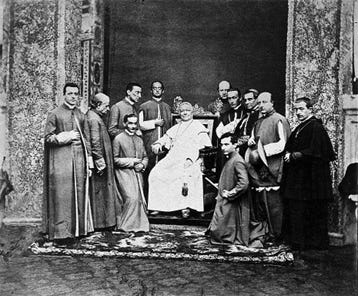
Pope Pius IX and Members of the Papal Court, 1868. Authors Fratelli D'Alessandri, Antonio d'Alessandri & Paolo d'Alessandri (1824-1889). https://commons.wikimedia.org/wiki/File:Pius_ix_cardinals.jpg

You might think of a multinational corporation’s CEO who is frustrated at the absence of uniformity in business systems. Consequently, they will typically institute tighter corporate direction and control over far-off branches engaging in bizarre and nonconforming varieties of institutional practice. The church in France and elsewhere in Europe had the tradition, critical mass, and freedom to maintain their Gallican stance and a carefully managed degree of independence from what Rome required, the Ultramontane position, as the French called it. However, the Irish ecclesiastical authorities lacked similar power and had fewer options.[2]
Post-Famine, from the early 1850s onwards, a Vatican-approved model of devotion was starting to replace people’s shared decisions about how they enacted their spiritual lives at the family or village level. Under clerical supervision, people would still pray within their church’s four walls but were supposed to disengage from sacred stones, wells, and trees in the natural environment. A new focus on religious uniformity, often called the devotional revolution, was promulgated by Irish bishops trained in Rome.[3]
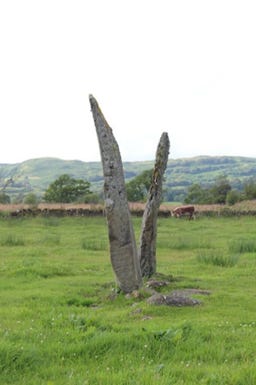
Standing Stones, Ballymeanoch (Baile Meadhonach), Kilmartin Glen, Scotland, 2011. Photographer Bob Embleton. https://commons.wikimedia.org/wiki/File:Ballymeanoch_standing_stones_-_geograph.org.uk_-_2571345.jpg

There was reasonable tolerance between Catholics and Protestants in Ireland in the early nineteenth century. However, a vigorous Protestant revivalist movement began, and Protestant missionaries set about winning converts. In 1852, the Dublin Evening Mail claimed that ten thousand people had recently renounced their Catholic faith in Connemara.[4] Inevitably, this undermined good relationships between the churches. Any evidence of Catholics successfully being converted, especially in the Famine’s wake, further energised the devotional revolution.
Supreme among the Catholic clerical leaders was Paul Cullen, Archbishop of Dublin from 1852 to 1878 and Ireland’s first cardinal. He was relatively indifferent to the archaic beliefs and heritage of the Catholic Church in Ireland. However, he was highly intent on establishing homogeneity and spiritual discipline along standardised lines.
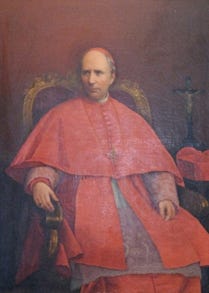
Cardinal Paul Cullen (1803-1878). Artist unknown. https://commons.wikimedia.org/wiki/File:Cardinal_Paul_Cullen_archbishop_of_Dublin.jpg

Before his appointment, some Irish bishops tried to improve theological knowledge and discipline among their priests, but others were said to be senile, incompetent, or uninterested.[5] Resulting from the strengthened orientation to Rome, what had once been ancient Irish connections with the Catholic establishments in Spain, France, and Belgium weakened as the Vatican’s influence grew.[6]
As she entered her teenage years, Maria could see the early stages of a significant transition about to take place in Irish spirituality, even though such changes would not take full effect until long after she had arrived in Aotearoa. Gradually came a more closely prescribed and integrated set of religious practices than their family had ever encountered. These slowly sidelined old Celtic rituals, such as processions to holy wells or sacred trees.
Intended reforms may start with much energy in Dublin in the east. Still, they may take months or years to infiltrate the Irish-speaking districts, the Gaeltacht, such as in Galway on the opposite side of the island. There was no complete or straightforward replacement of earlier spiritual practices by Vatican requirements, but the Rome-trained bishops’ impetus was powerful.[7]
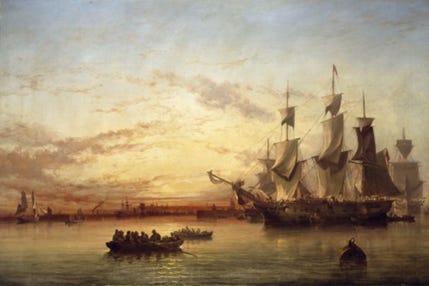
An Emigrant Ship, Dublin Bay, Sunset, 1853. Artist Edwin Hayes. National Gallery of Ireland. https://commons.wikimedia.org/wiki/File:1853_Dublin_Bay_by_Edwin_Hayes_National_Gallery_of_Ireland.png

By 1860, when Maria left for Aotearoa, Galway was feeling some effects of the devotional revolution. Of every 100 Irish people going to the Antipodes between 1841 and 1900, 63 departed after 1860.[8] The Irish migrants entering New Zealand after 1860 were more thoroughly affected by the newly prescriptive religious procedures.
Cullen’s direction became highly influential in the lives of Irish senior clergy. They were creating what came to be called an international Irish “Cullenite church” or an “episcopal imperialism” that would procure comprehensive authority in Ireland, the USA, Canada, Australia, New Zealand, and elsewhere.[9] As described in a following post, Patrick Moran, Catholic bishop in Dunedin from 1871 until he died in 1895, protégé (and nephew) of the Dublin cardinal, was a classic example of a Cullenite prelate.
The Irish church’s response to the social and cultural devastation of the 1840s Famine and the absence of other institutions that could support the people would enhance its power significantly and increase its reach into citizens’ lives. The people were beset by what Keneally called “[t]he stunned, impotent, supine spirit of post-Famine Ireland”.[10] This left them open to, then thankful for, strongly assertive clerical governance. The church was about to attain a vastly greater prerogative to control families’ lives than it had ever previously enjoyed.
Pre-Famine, only a minority of Catholics had been thought to attend Sunday Mass, most from the middle classes rather than the rural poor.[11] Typically, people were likely to participate at Mass just a few times a year, such as Christmas and Easter, feeling little need to be churchgoers more often, even if a priest had been locally available. Nor did most Irish Catholics observe strict religious requirements before the Famine.
However, for the next fifty years, from around 1850 under the Cullenite revolution, the populace increased its regularity in attending services, paid more substantial and consistent contributions to support priests and nuns, and increased the frequency of prayers in the home. The church established schools, hospitals, orphanages, and social welfare facilities to extend and diversify its offerings.[12]
As the church’s position in Ireland gradually strengthened after 1850, it grew in confidence, reinforced by alliances with members of the emerging Irish middle classes, such as low-level public servants, schoolteachers, merchants, and better-off farmers. Bishops set about imposing tighter controls upon parish priests, improving and monitoring their theological knowledge and pastoral activities.
The churches became vital meeting places for parishioners to undertake prayerful exercises such as attendance at benediction, recitation of the rosary, practising the forty hours of devotion, and undertaking novenas and devotions to the Sacred Heart. The clergy were supported by various lay organisations such as the St. Vincent de Paul Society and altar societies.[13]
The ancient Gaelic culture weakened in the face of the Irish bishops’ determined effort to standardise religious practice. In tandem came an Irish worldview evolving from premodern to modern and increasing familiarity with the English colonisers’ culture.[14] By 1900, a radical shift over 50 years had turned Ireland into a country exceptionally rigorous in its faith observances, with more than ninety per cent of people at Sunday Mass each week.[15]
In balance with the institutional church’s power was secular resistance. While many might have thought of clerical control as a necessary evil, the Irish never lacked the ability to express themselves.
One day Father Tracy met the Growler in the street and Father Tracy thought it the time and place to reason with him concerning his absence from mass. The Growler, whose endurance was being sorely tried by his wife’s nagging, lost his temper. In beautifully rounded periods, he told Father Tracy what he thought of him, as a man and a priest, what the village thought of him, the townland, the barony, the country, Ireland and the world. He cast aspersions on Father Tracy’s truthfulness, honesty and sanity. He insinuated that Father Tracy’s female ancestry could not well bear examination and that in the interests of posterity it was a very good thing that he had been priested.
Father Tracy turned pale and trembled with anger. ‘Do you realise’, he shouted, ‘that you are speaking to a priest of God? Do you realise that I could exercise my power and at this instant turn you into a stone?’
‘I don’t believe a word of it,’ answered the Growler. ‘But so be it that ye could, I hope someone would come by and pick me up and throw me at ye.’[16]
Yet, for those who remained in Ireland post-Famine, a growing sense of being fully part of a Rome-oriented church emerged to counter their feelings of cultural failure. For these, being Roman Catholic started to become as crucial as being Irish and then, at least for the next century, primarily defined for them what it was to be Irish.[17] This trend was accelerated by a slow diminishment in the native language’s everyday use.
When Irish as the common tongue and its cultural associations weakened, people’s increasingly Rome-aligned faith rather than their heritage and language reinforced their Irish character. The religion’s revitalisation in Ireland has been called one of the most powerful in the Catholic Church’s history.[18] Catholicism rather than the Irish language and archaic Celtic culture started to form the basis of Irish identity.
Ireland’s devotional revolution eventually created a church moral monopoly that was deeply controlling, puritanical, patriarchal, and paternalistic, building an intensifying social and economic authority. Religion had become standardised but at a cost. The church gradually increased its influence over the country’s health, welfare, and social systems, subjugating individuals’ spiritual, sexual, and family lives.
Although liberalisation started to occur in the wake of the Second Vatican Council (1962-65), a repressive ecclesiastical grip on the population’s religious, sexual, and social practices persisted into the 1990s in the context of a profound societal conservatism. But the church’s hold on the lives of the populace was broken by deep scandals such as revelations about the physical and psychological cruelty meted out to young women and girls in church institutions such as the Magdalene Laundries.
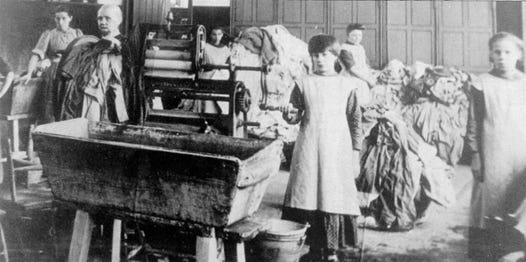
Unidentified Magdalene Laundry in Ireland, circa early 20th Century. Scanned by Eloquence from F. Finnegan (2001) Do penance or perish, Congrave Press. https://commons.wikimedia.org/wiki/File:Magdalen-asylum.jpg

Eventually, free access to condoms was won in 1993, divorce became permissible in 1995, and legal abortion was achieved in 2018.[19]
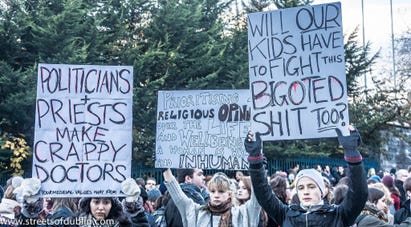
Dublin Savita Halappanavar Rally. Photographer William Murphy, 2012. https://commons.wikimedia.org/wiki/File:About_Ten_Thousand_People_Attended_A_Rally_In_Dublin_In_Memory_Of_Savita_Halappanavar.jpg

Multiple sexual abuse scandals involving clerics and other religious authorities in the 1990s shattered much of people’s remaining trust in the institution.
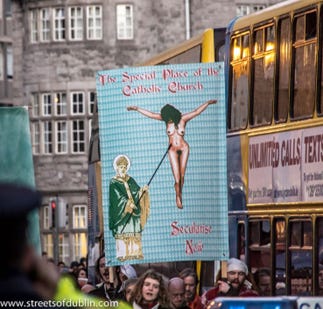
Dublin Savita Halappanavar Rally (Savita being a 31-year-old woman who was refused an abortion and died following a miscarriage at University Hospital Galway.) Photographer William Murphy, 2012. https://commons.wikimedia.org/wiki/File:Dublin_Savita_Halappanavar_Rally_81.jpg

Everyone saw first-hand how Lord Acton’s dictum had played out in their country: power tends to corrupt, and absolute power corrupts absolutely. Even some of the hierarchy began to recognise secularisation’s merits, with the Archbishop of Dublin remarking that people would mainly not want their country to return to clerical domination.[20]
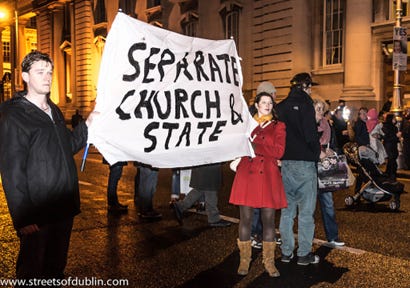
Dublin Savita Halappanavar Rally. Photographer Night Owl, 2012. https://commons.wikimedia.org/wiki/File:Dublin_Savita_Halappanavar_Rally_21.jpg

Education and Literacy
By 1844, when Maria was born, the great majority of the eighteenth-century English penal laws (e.g., forbidding education from 1723 to 1782 for Irish Catholic children) were no longer in force. A few random oddities persisted, such as it was illegal for a Catholic priest to marry a Catholic to a Protestant; this was not repealed until 1870.[21] Nevertheless, serious consequences lingered. The Conservative statesman Edmund Burke had described the laws as an
elaborate contrivance, as well fitted for the oppression, impoverishment and degradation of a people, and the debasement in them of human nature itself, as ever proceeded from the perverted ingenuity of man.[22]
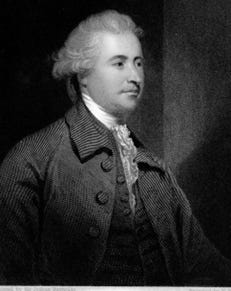
Edmund Burke, artist Joshua Reynolds. https://commons.wikimedia.org/wiki/File:Burke.jpg

In Ireland’s oppressed, impoverished, and degraded state, even after repeal of the penal laws, there were severe impediments to schooling for all. Still to be achieved were constructing schools, training teachers, finding the funding to pay teachers, and producing and disseminating learning and teaching materials.
Building an education system might have been more straightforward if the Irish had owned any substantial proportion of their country. However, the systematic dispossession of the majority meant that by late in the eighteenth century, Catholics owned only five per cent of the land.[23] Much of the other ninety-five per cent was controlled by landlords, most of them overseas, who typically had little interest in improving social or economic conditions in Ireland.
Thus, the great majority of the population cultivated the soil for a subsistence income but had virtually no control over the ground they worked and usually no economic surplus to invest in an education system.
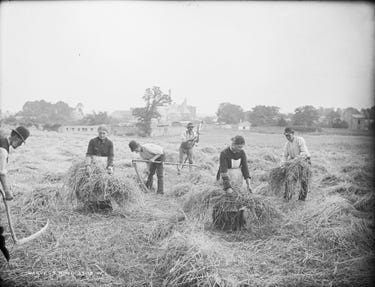
Harvest Time, circa 1897. National Library of Ireland on the Commons. https://commons.wikimedia.org/wiki/File:Harvest_Time_(5984094240).jpg
.jpg)
During the nineteenth century, the province of Connacht (comprising the five counties of Galway, Leitrim, Mayo, Roscommon, and Sligo) had Ireland’s highest percentage of those unable to read or write. In 1871, forty-nine per cent of people there aged five and above were not literate, compared to the all-Ireland illiteracy rate of thirty-three per cent in the same year.
Yet just ten years later, in 1881, in Connacht, the illiteracy rate had dropped to thirty-eight per cent in the province, compared to the whole of Ireland at twenty-five per cent illiteracy.[24] On the one hand, this provides good evidence that people were doing everything possible to build their literacy. However, while other European countries were expanding in the thirty years before 1881, the population of the western counties in Ireland had collapsed to fewer than one-half of its former extent.[25] Many of the poorest and least educated had died or emigrated in those years.
Over the previous two centuries, colonisation’s processes undermined the people’s traditional clan structures, social institutions, and economy. Then, when the Famine struck, even the language was undercut since, for their economic survival, the Irish were forced to try to learn English. Historians relate how a deathly silence progressively fell upon the West’s remote villages, the language’s last major stronghold, starting in the Famine’s worst days. Parents and grandparents, knowing only Irish, resolved they would no longer speak to their children and grandchildren. They realised that these children had somehow to learn English if they were not to perish.[26]
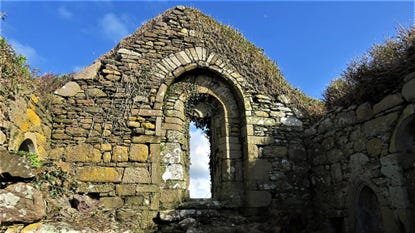
Church Ruins, Dingle Peninsula, County Kerry, 2022. Photographer Maoileann. https://commons.wikimedia.org/wiki/File:Ruins-9055,_Dingle_Peninsula,_Co._Kerry,_Ireland.jpg

The Irish were in a deep poverty trap, but they understood the power of knowledge. If their children were to survive, parents knew they had to create a more robust and systematic education system than their informal and clandestine hedge schools had ever been. For a period, the illegal hedge schools were the only available education for children, who often attended for three to five years.[27]
They were taught in ever-changing locations such as homes or barns in wet weather or the shelter of stone walls, ditches, or copses on dry days. As well as teaching literacy, the hedge schools maintained a tradition of oral storytelling, supporting family practices of recounting literary tales remembered from past generations in “a highly cultivated oral and written medium”.[28]
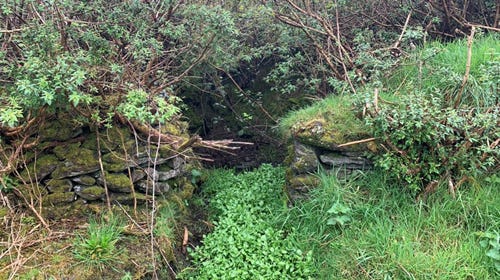
Hedge School, near Ventry (or Ceann Trá, a Gaeltacht village) County Kerry, 2021. Photographer Mskellig. https://commons.wikimedia.org/wiki/File:Ventry-CoKerry-Hedge-school.jpg

Teaching was typically provided by passionate individuals whose enthusiasm might have exceeded their pedagogical ability, but teacher training was impossible in hazardous and covert situations. Parents paid itinerant tutors whatever they could afford in cash or food for their children to learn reading and writing, along with grammar, particularly in English, sometimes in Irish, arithmetic, occasionally Latin or Greek, history, and home economics.[29]
Although the hedge schools were known to have persisted into the 1890s, they gradually became less significant following the British government’s establishment of a national school system during the 1830s, following the 1831 Education Act. The government hoped that a national training and education system would replace the current hedge schools, criticised for their irregular places of learning, uneven quality among teachers, and unpredictable curricula.[30]
Maria’s family felt conflicted about the language or languages children should learn. British influence had always been at its weakest in Ireland’s west, and in the 1850s, in Galway and elsewhere in the west, more than eighty per cent of citizens knew and used their native language.[31] Of the four Irish provinces, Connacht still has the largest proportion of those fluent in Irish.[32]
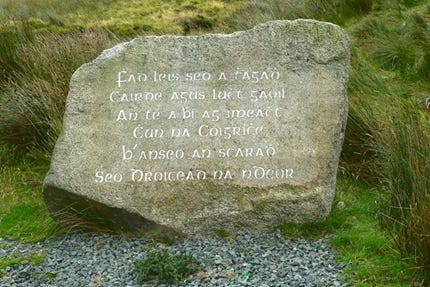
Bridge of Tears: Roadside Gaelic Monument, County Donegal. The leave-taking point from which emigrants walked to their ships, and remaining family members returned to their homes. Photographer Joseph Mischyshyn, 2005. Translation: “Family and friends of the person leaving for foreign lands would come this far. Here was the separation. This is the Bridge of Tears”. https://commons.wikimedia.org/wiki/File:Bridge_of_Tears_-_Roadside_stone_Gaelic_monument_-_geograph.org.uk_-_1185235.jpg

Especially in the far west, people saw that since the Famine had devastated their society, they had to reject their old culture in some respects. They needed to become familiar with the occupying power’s language, systems, and expectations. In an unforgiving world, their children would be profoundly handicapped if they had no English. This was one of the critical understandings within the hedge schools. Historically, English had been mainly the language of instruction since teachers likewise wanted to ensure that children had their best chance of surviving. Nonetheless, parents were worried about how their children could communicate with and learn from their grandparents and extended family if they lost their native language.
When Maria was six, almost half of those aged five and older were unable to read or write in English. Twenty years later, in 1871, about two-thirds could at least read in English; by 1901, eighty-six per cent wrote in that language.[33] A planned provision of education across Ireland was getting underway, albeit unevenly. Forty years on, ten years after Maria had arrived in Aotearoa, one commentator said
The Irish people have always, even in the darkest period of the penal laws, been greedy for knowledge, and few races showed more quickness in acquiring it. The admirable system of national education established in the present century is beginning to bear fruit, and among the younger generation at least, the level of knowledge is quite as high as in England.[34]
The government hoped that the new national education system would feature cooperation among Anglicans, Presbyterians, and Catholics. However, the Anglican church primarily saw the new arrangements interfering with its previous educational efforts for children of its faith. At the same time, the Presbyterians felt that the new schooling system by no means honoured their position. The Anglican Archbishop of Dublin was reported as having said that the national schools being set up in Ireland were “gradually undermining the vast fabric of the Irish Roman Catholic Church” and that the national schools were “an instrument of conversion”.[35]
Revelations of this kind, of course, reinforced Catholic prejudice against them, confirmed their suspicions about the purpose of the schools and hardened their belief that their children needed Catholic schools.
Irish families were also concerned that the national education system did little to respect their culture. The curriculum included no Irish language, history, culture, or games. The majority of children who attended remained only until they could read, exiting to make way for other children before they learned to write.
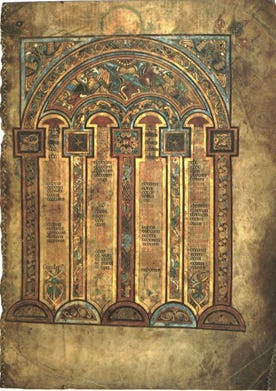
Canon Table, Book of Kells. Trinity College Dublin. From B. Meehan, The Book of Kells, 1994. https://commons.wikimedia.org/wiki/File:KellsFol002rCanonTable.jpg

Even in 1870, a decade after Maria had emigrated, only about a third of school-age children were regularly in class, usually due to family poverty.[36] This statistic, though, refers to school attendance countrywide. The proportion of students within the national educational system in the less affluent Gaeltacht, the Irish-speaking far west, such as Galway, would have been lower again. As the Catholic church’s influence over children’s schooling gradually strengthened during the 1800s, it worked to remove hedge schools, seeing them as too unofficial and challenging to control.
Before 1879, it was forbidden to teach Irish in national schools, and Irish was not taught there during school hours until 1900. In a significant new development in 1904, Irish, for the first time, was the primary instructional medium in national schools in Irish-speaking areas.[37]
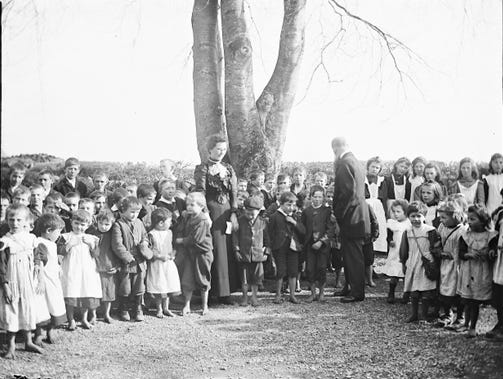
Kilglass National School, Ahascragh, Galway, circa 1902. Photographers Dillon Family. National Library of Ireland on the Commons. https://commons.wikimedia.org/wiki/File:Mostly_barefoot_schoolchildren_Kilglass_National_School,_Ahascragh,_County_Galway,_1900s_(17254839892).jpg
.jpg)
Because of the resources invested in children’s education, literacy was starting to show substantial improvement in the rest of the U.K. and Ireland. However, in Ireland, in tandem with literacy’s growth, came an enhanced awareness of the nationalist cause. People read more at all societal levels and discussed their aspirations for self-government together.
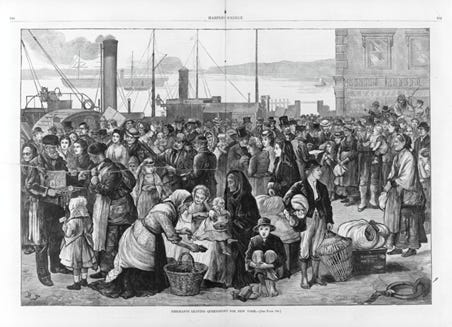
Emigrants Leaving Queenstown for New York, 1874. Illustration in Harper’s Weekly, 26 September. Library of Congress. https://commons.wikimedia.org/wiki/File:Emigrants_leaving_Queenstown_for_New_York_-_M.F._LCCN92513178.tif
A surge of cheap publications appeared, including nationalist newspapers, historical novels, political arguments, and ballads, all beginning to create a ferment of discussion, enlarging the population’s cultural and social self-awareness. Increasing literacy enabled people to get in-depth information about their past, battles, wars, injustices, defeats, victories, etc., beyond what they had already heard from the storytellers in less-literate times. New knowledge consolidated the sense of who they were as nineteenth-century Irish citizens.[38]
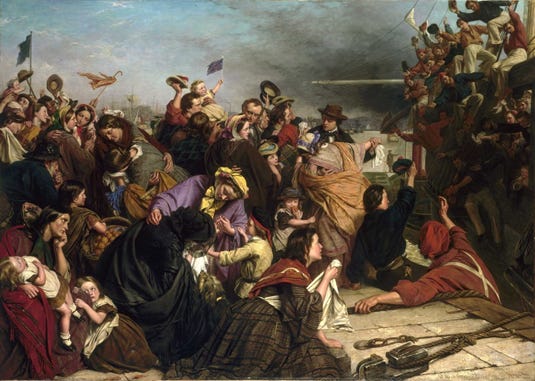
The Parting Cheer: Departure of an Emigrant Ship, 1861. Artist Henry Nelson O’Neil. Royal Museum Greenwich. https://commons.wikimedia.org/wiki/File:The_Parting_Cheer_RMG_F3201.tiff
As Maria prepared to depart, she knew that Irish political prisoners were still being shipped iron-fettered to provide unpaid labour in Australia. This practice would not cease until eight years later, when on 10 January 1868, the last consignment of over 60 Fenians was deposited into Western Australia’s arid and sweltering gulag. This was one of the more daunting environments for convicts or any migrants. There was thought to be only a slight risk of anyone escaping since the desert to the east was considered impassable for Europeans except the very best equipped.
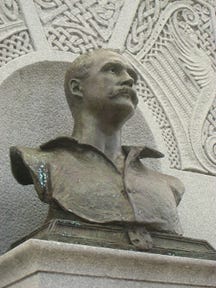
John Boyle O’Reilly Memorial, 1896, Boston, USA. Sculptor D.C. French, Photographer not stated, 2009. https://commons.wikimedia.org/w/index.php?search=John+Boyle+O%E2%80%99Reilly&title=Special:MediaSearch&go=Go&type=image
Maria might have heard that a prison reform movement in London called the Howard League had censured Western Australia’s prison system for its pointless mental and physical cruelties.[39] One among the Fenian prisoners, John Boyle O’Reilly, a poet and journalist, was accused of being too slow as he walked along a stretch of road. His punishment was to have no messages from home for six months. A warder showed him a black-bordered letter that had just arrived, the borders signalling that the letter contained bad news. When handed it six months later, he learned of his mother’s death.[40]
Eighteen-sixty-eight marked eight decades of England depositing its so-called criminal classes, social excretion, malefactors, and malcontents such as Irish patriots onto Australia and Norfolk Island’s unwelcoming shores.
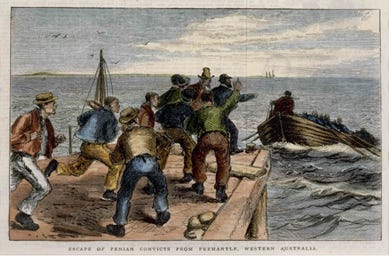
Escape of Fenian Convicts from Fremantle, Western Australia, 1876. Unknown author. Australian National Maritime Museum. https://commons.wikimedia.org/wiki/File:Escape_of_Fenian_convicts_from_Fremantle,_Western_Australia_-_Australasian_Sketcher.jpg

For many years, the Irish had comprised a substantial proportion of the British armed forces, in 1872 accounting for a quarter of NCOs, corporals and privates in the regular army.[41] Hence, many were tired of serving as foot soldiers and cannon fodder in England’s seemingly endless wars. Britain had become the world’s most powerful country following comprehensive victories over France, its greatest national rival, in a long-lasting competition to be the premier superpower. In sporadic warfare between 1689 and 1815, England and France battled each other in seven wars in Europe, North America, Asia, and the West Indies.[42]
In Ireland in the nineteenth century, the impetus to migrate remained urgent. Historically, the USA had been a principal destination of choice, but the Irish knew of rising tensions between the North and South. They became apprehensive about finding themselves in the thick of another war zone: In America, are you not about to have a civil war? Will brother not fight brother? And will Irishmen not be fighting other Irishmen?
Coming up in future posts:
Muskets Became an Ill-fated Necessity as the People Prepared to Defend Themselves against Northern Aggression.
The People Were Offered up as a Sordid Sacrifice on the Glittering Altar of Commerce.
The Peace of the Pākehā is More to be Feared Than His War.
The Missionary, the Bishops, and the Drunken Whalers.
A Pure City of God on Dunedin’s Unsullied Hills.
The Independence and Cheek of the Labouring Class, Particularly of Female Domestic Servants, Is Beyond All Endurance.
Squatters Rush in, Rabbits Rampant, and Too Many Flocking Sheep.
Gold, a Wedding, Injury, and One More Throw of the Dice.
An Irruption of Strenuous Men, a Ranting, Roaring Time.
But the Thief, Complete With Door, Outran Him and Disappeared into the Raggedy Ranges.
Saddle Hill: Beyond Dunedin’s Disgusting Malodorous Effluvia and a Pestilence of Blowflies.
“Well, No”, Countered The Digger, “But I’ll Give You Sixpence if You Polish Me Boots”.
A Burden Almost Too Grievous to be Borne and Making Shipwreck of Their Virtue.
The Irish Spiritual Empire, a Cycle of Sectarian Epilepsy, and a Certain Fat Old German Woman.
Better at the Language Than Those Who Owned It and Equally Determined to be Both Themselves and to Conform, Fit In.
I Found It a Matter of No Small Difficulty to Collect the Bills Due by Females Who Have Been Assisted to the Colony.
Her Skirt Would Stand up Straight By Itself and Have to be Thawed Out.
His Wife Burst into Tears, Saying She Had Already Mortgaged Their Home so She Could Pay for Her Own Dredge Speculations.
An Irresistible Feeling of Solitude Overcame Me. There Was No Sound: Just a Depressing Silence.
Norman Conceded in his Mind that the Boomerang Would Crash Home Before He Could Snatch Out His Revolver.
The Sin of Cheapness: There Are Very Great Evils in Connection with the Dressmaking And Millinery Establishments.
The Poll Tax: One of the Most Mean, Most Paltry, and Most Scurvy Little Measures Ever Introduced.
Notes
[1] Barr, ‘An Italian of the Vatican type’.
[2] Breathnach, ‘Irish Catholic identity’.
[3] Larkin, ‘The devotional revolution’; Barr, ‘Imperium in imperio’.
[4] Jackson, Churches and people, pp. 12, 86-7.
[5] Jackson, Churches and people, p. 13.
[6] Comerford, ‘Ireland 1850-70’, p. 387; de Paor, Peoples of Ireland, p. 258.
[7] McGrath, ‘The Tridentine evolution of modern Irish Catholicism’.
[8] Jackson, Churches and people, p. 19.
[9] Breathnach, ‘Irish Catholic identity’, pp. 7-9.
[10] Keneally, The great shame, p. 309.
[11] Larkin, ‘Church, state, and nation’.
[12] Akenson, Half the world from home, p. 65.
[13] O’Day, ‘Imagined Irish communities’, p. 260.
[14] Laracy, ‘Patrick Hennebery in Australasia’, p. 113.
[15] Devine, To the ends of the earth, p. 131; Jackson, Churches and people, p. 15.
[16] Barrington, ‘Men are never’, p. 39.
[17] Larkin, ‘Church, state, and nation’.
[18] Jackson, Churches and people, p. 48; MacDonagh, The economy and society, p. 234.
[19] Malešević, Religious regulation in Ireland.
[20] Malešević, Religious regulation in Ireland.
[21] Vaughan, ‘Ireland c.1870’, p. 735.
[22] Cited in Arkins, ‘The commercial aspect’.
[23] Donald Akenson, personal communication.
[24] Akenson, Half the world from home, p. 79.
[25] Keneally, The great shame, p. 608.
[26] de Paor, The peoples of Ireland, p. 255.
[27] Akenson, ‘Pre-university education, 1782-1870’.
[28] Akenson, ‘Pre-university education, 1782-1870’, pp. 523-524.
[29] Keneally, The great shame, p. 29.
[30] Akenson, The Irish education experiment.
[31] Keneally, The great shame, p. 17.
[32] Irish Central Statistics Office.
[33] Walsh, ‘The national system of education’.
[34] Molloy, ‘Victorians, historians and Irish history’, p. 161.
[35] Jackson, Churches and people, p. 87.
[36] Walsh, ‘The national system of education’.
[37] Walsh, ‘The national system of education’.
[38] Molloy, ‘Victorians, historians and Irish history’, p. 158.
[39] Keneally, The great shame, p. 482.
[40] Keneally, The great shame, p. 496.
[41] Vaughan, ‘Ireland c.1870’, p. 793.
[42] Devine, To the ends of the earth, p. 1.
References
Akenson, D.H. (1970). The Irish education experiment: The national system of education in the nineteenth century, London. Cited in https://www.encyclopedia.com/international/encyclopedias-almanacs-transcripts-and-maps/education-primary-public-education-national-schools-1831
Akenson, D.H. (1989). ‘Pre-university education, 1782-1870’. In A new history of Ireland, vol. 5, Ireland under the union, I, 1801-1870. W.E. Vaughan, (Ed.). Clarendon Press, pp. 523-537.
Akenson, D. H. (1990). Half the world from home: Perspectives on the Irish in New Zealand, 1860 to 1950, Victoria University Press.
Akenson, personal communication, citing evidence for five per cent Catholic ownership in the timeframe 1775-82 and indicating that the literacy rate of people in the migration age group, roughly 15-30 years, was relatively stronger than the provincial average.
Arkins, T. (1912). ‘The commercial aspect of the Irish Penal Code’. Studies: An Irish Quarterly Review, 1, 2, pp. 257-273.
Barr, C. (2008). ‘‘Imperium in imperio’: Irish episcopal imperialism in the nineteenth century’. English Historical Review, CXXIII, no. 502, pp. 611-650.
Barrington, M. (2020). ‘Men are never God’s creatures’. Reprinted in The art of the glimpse: 100 Irish short stories, selected by Sinéad Gleeson. Apollo, pp. 32-41.
Breathnach, C. (2013). ‘Irish Catholic identity in 1870s Otago, New Zealand’. Immigrants and Minorities, 31, 1, 1-26.
Comerford, R.V. (1989). ‘Ireland 1850-70: post-famine and mid-Victorian’. In A new history of Ireland, vol. 5, Ireland under the union, I, 1801-1870. W.E. Vaughan, (Ed.). Clarendon Press, pp. 372-395.
De Paor, L. (1986). The peoples of Ireland. London: Hutchinson.
Devine, T.M. (2011). To the ends of the earth: Scotland’s global diaspora 1750-2010. Allen Lane.
Irish Central Statistics Office (2023). https://www.cso.ie/en/index.html
Jackson, H.R. (1987). Churches and people in Australia and New Zealand 1860 to 1930. Allen & Unwin / Port Nicholson Press.
Keneally, T. (1998). The great shame: A story of the Irish in the old world and the new. Random House.
Laracy, H. (2002). ‘Patrick Hennebery in Australasia, 1877 to 1882’. In The Irish in New Zealand: Historical contexts and perspectives, B. Patterson, (Ed.). Victoria University of Wellington, pp. 103-116.
Larkin, E. (1972). ‘The devotional revolution in Ireland, 1850-75’. The American Historical Review, 77(3), 625-652. doi:10.2307/1870344
Larkin, E. (1975). ‘Church, state, and nation in modern Ireland’. American Historical Review, 80, 5, 1244 –1276. DOI: 10.2307/1852059
MacDonagh, O. (1989). ‘The economy and society, 1830-45’. In A new history of Ireland, vol. 5, Ireland under the union, I, 1801-1870. W.E. Vaughan, (Ed.). Clarendon Press, pp. 218-241.
Malešević, V. (2019). Religious regulation in Ireland. In Oxford research encyclopedia of politics. Oxford University Press. doi: http://dx.doi.org/10.1093/acrefore/9780190228637.013.805
McGrath, T.G. (1991). ‘The Tridentine evolution of modern Irish Catholicism, 1563-1962: A re-examination of the ‘Devotional Revolution’ thesis’. British Catholic History, 20, pp. 512-523. Here, McGrath sets out to refute several aspects of Larkin’s devotional revolution thesis, and his paper is worth reading as an alternative perspective in the debate.)
Molloy, K. (2002). ‘Victorians, historians and Irish history: A reading of the New Zealand Tablet 1873 to 1903’. In The Irish in New Zealand: Historical contexts and perspectives. B. Patterson (Ed.). Victoria University of Wellington, pp. 153-170.
O’Day, A. (2007). ‘Imagined Irish communities: Networks of social communication of the Irish diaspora in the United States and Britain in the late nineteenth and early twentieth centuries’. In Irish migration, networks and ethnic identities since 1750. D.M. MacRaild, & E. Delaney (Eds.) Routledge, pp. 250-275.
Vaughn, W.E. (1989). ‘Ireland c.1870’. In A new history of Ireland, vol. 5, Ireland under the union, I, 1801-1870. W.E. Vaughan (Ed.). Clarendon Press, pp. 726-800.
Walsh, T. (2016). ‘The national system of education, 1831 to 2000’. In Essays in the history of Irish education, B. Walsh (Ed.). Palgrave Macmillan, pp. 7-43.